
Registering a transport company in Denmark takes two separate approvals. First you form the company and get it registered on Virk, the state business portal. Then you apply to the Danish Road Traffic Authority (Færdselsstyrelsen) for the permit that lets you carry goods or passengers for hire. The company registration alone does not allow you to drive a single paid job. Most delays come from the second step, because the permit depends on a qualified transport manager, documented equity and a clean public-debt record.
This guide walks through the order of events for founders who want to run a haulage, van or taxi business, with the figures the authorities publish. We are Votra: Votra Danmark ApS runs the haulier courses, and Votra Business ApS acts as an external operations and finance department for transport companies. Where either helps at a given step, we say so.
TL;DR
- Form an ApS (minimum capital DKK 20,000) or an A/S (DKK 400,000), then register it on Virk within two weeks of signing the memorandum of association.
- The CVR number is issued when the company is registered. VAT registration is a separate application and must be filed at least 8 days before you start business.
- Haulage over 3,500 kg, national van haulage over 2,500 kg and taxi or limousine work each need a permit from Færdselsstyrelsen, usually valid for up to 10 years.
- Equity requirements and processing times differ by permit type: plan for roughly 6 to 8 weeks for taxi and van permits, and have your documentation complete before you apply.
- A qualified transport manager is the part most founders need to arrange first.
Table of Contents
- The order that works
- Step 1: Choose the legal form
- Step 2: Register on Virk and get a CVR number
- Step 3: Find out which permit you need
- Step 4: The transport manager
- Fees and processing times
- What changed recently
- Step 5: Employer, VAT and tax from day one
- Where we can take work off your hands
- Perspective
- FAQ
- Sources
The order that works
Founders often register the company first and only then discover that the permit has requirements the company does not yet meet. A sequence that avoids this:
- Decide the legal form and the type of transport you will do (trucks, vans or passengers).
- Secure a transport manager who meets the professional-competence requirement.
- Form the company, pay in the capital and register it on Virk.
- Register for VAT and as an employer if you will have staff.
- Apply for the permit, with equity documentation ready.
- Register vehicles, road-toll equipment and driver documents before the first job.
The Danish industry overview on Lovguiden describes the same logic: the haulage permit and an approved transport manager come before the first job, with company, VAT and road-toll obligations handled at start-up. Unlicensed haulage is punished with a fine, and an issued permit can be withdrawn if the requirements stop being met.
Step 1: Choose the legal form
Most new Danish transport companies are either a sole proprietorship (enkeltmandsvirksomhed) or a private limited company (ApS). The permit requirements below apply to the company holding the permit, and the equity requirements in particular make a limited company the natural vehicle for a growing fleet.
According to the Danish Business Authority (Erhvervsstyrelsen), the minimum capital is DKK 20,000 for an ApS and DKK 400,000 for an A/S. At least 25% must be paid in, and never less than DKK 20,000. For a typical start-up the ApS is the realistic choice.
What you need to prepare:
- A signed memorandum of association (stiftelsesdokument) and articles of association (vedtægter).
- An owner register.
- Proof that the capital has been paid into a company account or to a lawyer, confirmed by a bank, lawyer or auditor.
The same guidance states that registration can happen only after the capital is paid in, and that you must register within two weeks after signing the memorandum. Sign too early and you run into that deadline before the bank has confirmed the money.
Step 2: Register on Virk and get a CVR number
The CVR number is the company’s identity in the Central Business Register. You receive it when the company is registered through Virk’s “Start Company” self-service. Danish residents log in with MitID and a CPR number. According to the Business in Denmark guidance, people without a Danish MitID can still register and obtain a CVR number through the form Registration of Non-Danish Company (Start-40.112).
CVR and VAT are not the same thing
Searchers often ask whether the CVR number is also the VAT number. The two are linked, but registering a company does not register it for VAT. VAT is a separate duty, and the same Business in Denmark page says the VAT application must be submitted no later than 8 days before you start business. Late, missing or incorrect applications can be fined. Passenger and van permits also check that the company is registered correctly, so do not leave VAT until the first invoice.
Step 3: Find out which permit you need
This is the step that separates a transport company from any other new business. The permit is issued by Færdselsstyrelsen, applied for digitally through Virk.
Trucks and heavy haulage
Under the Danish Haulage Act, anyone established in Denmark who carries goods for hire with a vehicle or combination over 3,500 kg needs a permit. The act also covers national van haulage over 2,500 kg with goods over 11 kg per piece. Permits are issued for up to 10 years.
For a community licence for trucks over 3.5 tons, Færdselsstyrelsen requires an effective and stable establishment in Denmark, professional competence, appropriate financial standing, public arrears of no more than DKK 50,000 and good repute. The equity requirement is DKK 150,000 for the first two licences and DKK 40,000 for each additional one.
Vans between 2 and 3.5 tons
For a van licence, the authority asks for equity or collateral of at least DKK 13,500 for the first licence and DKK 6,750 for each subsequent one. You document it with an auditor’s statement, a bank or insurance guarantee or the latest audited annual report. A newly founded company uses an opening balance.
Once the permit is granted, you must register the permit number to a specific van in MitVirk before lawful hire haulage can begin. The conditions must stay fulfilled for the whole validity period, and the authority supervises them continuously.
Taxi, limousine and other passenger transport
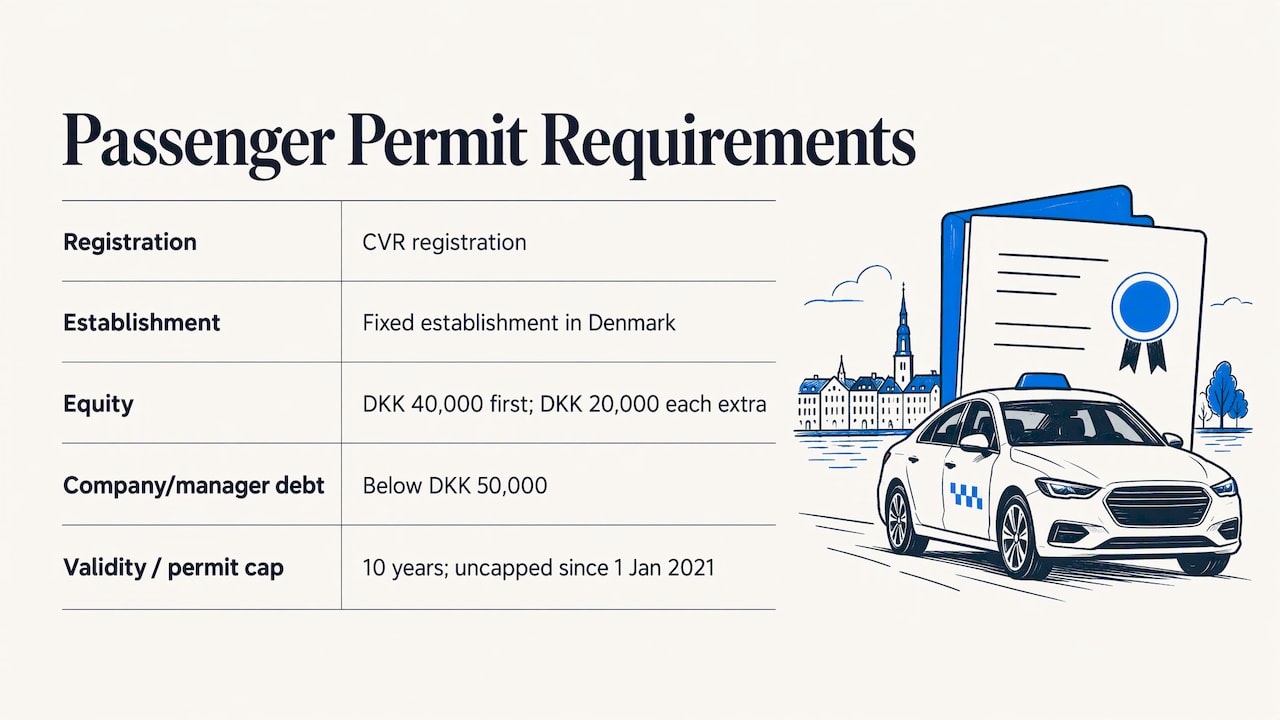
For commercial passenger transport, Færdselsstyrelsen requires a CVR registration, a fixed establishment in Denmark, equity of DKK 40,000 for the first permit and DKK 20,000 for each subsequent one, and no public debt of DKK 50,000 or more for the company or its transport manager. Permits last ten years, and since 1 January 2021 there is no cap on the number of permits.
Step 4: The transport manager
Every permit above rests on a transport manager: the person who actually and continuously manages the transport activity and holds the required professional competence. For haulage that competence is documented by passing the haulier exam. For a founder who is not a haulier yet, this is the first practical task.
Two details from the authority’s guidance are worth knowing early:
- For passenger transport, the manager applies for the permit using an employee signature that the business owner has ordered. If the manager has lived abroad, an original criminal record from that country has to be sent by post to Færdselsstyrelsen by the issuing authority itself. Order it well ahead.
- A manager whose approval was revoked can be re-approved no earlier than three years after the revocation, and only after passing the relevant haulier exam again.
If you want to qualify yourself, our haulier course for trucks and haulier course for vans are built around the Danish regulatory requirements for the sector and are offered in several languages, with online self-paced study and live exam slots. Truck haulier training is on our Vognmand til Lastbil page at DKK 14,900 to 16,900 one-off, and van haulier training on Vognmand til Varebil at DKK 6,900 to 8,900 one-off. For taxi work, see our taxi training and the English overview of taxi driver training in Denmark; the course itself is taught in Danish.
Fees and processing times
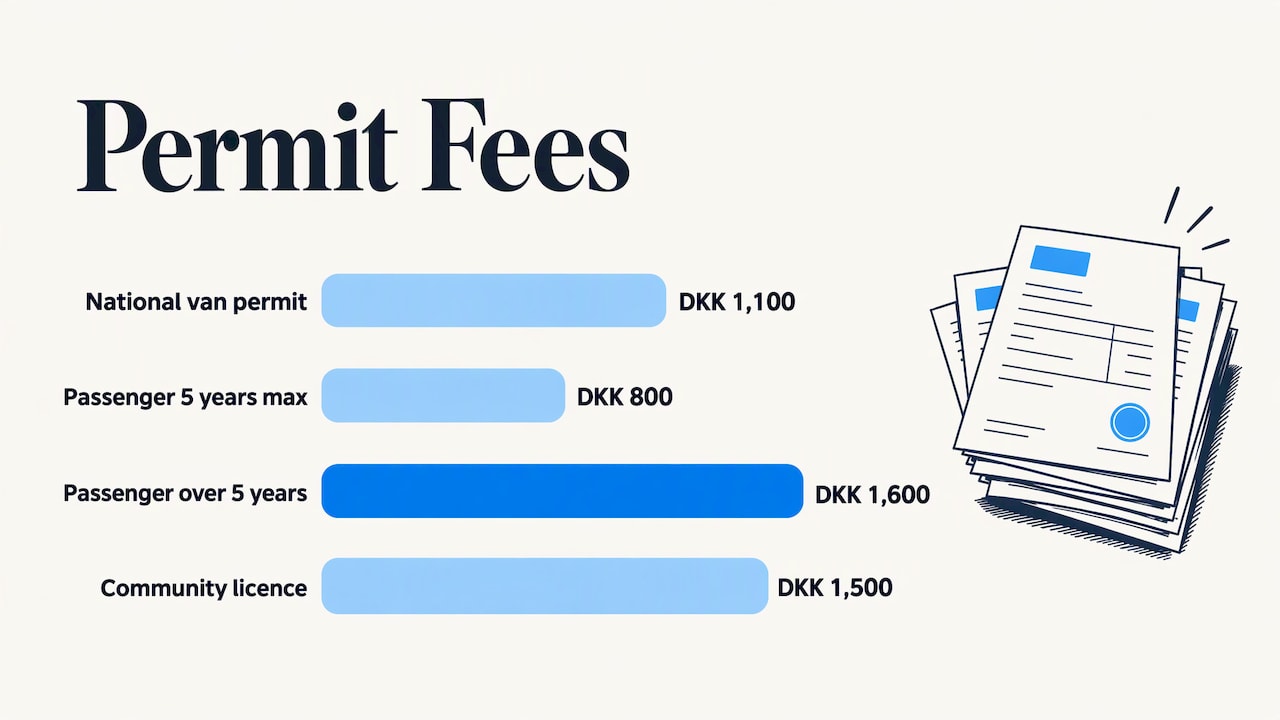
The fees below are the state’s, paid to Færdselsstyrelsen. They were set for 2026 and are adjusted by regulation, so confirm them on the linked pages before you apply.
| Permit | Fee | Official target time |
|---|---|---|
| National van haulage permit (issue or renewal) | DKK 1,100 from 1 January 2026 | Written decision within 8 weeks (60 days) |
| Passenger transport permit, valid up to 5 years | DKK 800 | 6 to 8 weeks |
| Passenger transport permit, valid over 5 years | DKK 1,600 | 6 to 8 weeks |
| Community licence, haulage over 3,500 kg (issue, renewal, replacement, each certified copy) | DKK 1,500 | Set per case |
Two practical points. Processing of a passenger permit does not start until the equity documentation is in, and an opening balance used as documentation must not be more than 18 months old. For vans, the authority may extend the 8 weeks if it needs more information, and the decision arrives in the company’s digital postbox, so someone has to read that postbox.
Changes to an issued van permit cost DKK 570 per started hour from 1 January 2026, according to the same van-haulage guidance. A complete first application is cheaper than a corrected one.
What changed recently
Applications for haulage permits must now go through digital self-service on Virk, and the van’s registration number has to be reported through Virk before it is used for hire haulage. Capital requirements are adjusted every 1 January, so a figure you read in an old guide may be out of date. Færdselsstyrelsen also reports that its supervision of community licences averaged 55 days in 2024, 59 days faster than in 2023. The checks it runs include financial standing, public debt, VAT registration, vehicles returning to Denmark at least every 8 weeks and a sufficient Danish operating base. In other words, the permit is not a one-time hurdle: the same points are looked at after you start.
Step 5: Employer, VAT and tax from day one
Once the company exists and the permit is in progress, the ongoing duties start:
- VAT. Register before you start, as above. How often you file depends on turnover, so check the schedule the Danish Tax Agency assigns you.
- Payroll. Employers must register as employers and withhold A-tax and the 8% labour market contribution (AM-bidrag) from wages, declaring and paying monthly, according to Business in Denmark.
- Annual report and corporate tax. A limited company files an annual report with Erhvervsstyrelsen and pays corporate tax in instalments. Your accountant sets the calendar.
- Road toll. Heavy goods vehicles pay Danish road toll on the tolled network, and the registered owner needs the right equipment before driving. Fines for missing equipment are issued automatically.
- Driver documents. Licences and driver qualification cards have expiry dates that need watching.
This is where many new hauliers lose time. A one-truck business has the paperwork of a company with ten employees, and the driver is usually the person who also does the bookkeeping at night.
Where we can take work off your hands
If you are setting up a transport company, our Virksomhedsopstart service from Votra Business covers company formation. After the start, Votra Business works as an external operations and finance department for haulage and transport companies: bookkeeping, VAT, payroll administration, invoicing, debtor follow-up, an overview of the finances, administrative fleet management and monitoring of driver documents and deadlines. It is offered in three plans, Business, Business+ and Business Partner.
If you also need the qualification, the haulier courses come from Votra Danmark, a separate company under the same brand. That means one place to start from both ends: the training that gets the transport manager approved, and the administration that keeps the permit conditions documented once you are running.

If you are unsure where to begin, start with the course page that matches your vehicle type or the business start-up page.
Perspective
Founders usually ask us about the company form first. In our experience the better question is who will be the transport manager, because the permit cannot move forward without that person, and the equity and public-debt rules are tied to how the company is set up.
That is why we see training and administration as one path rather than two. The haulier course gives you the competence the permit requires. The administration afterwards, VAT, payroll, invoicing and the follow-up of driver documents and deadlines, is what keeps the permit conditions intact for the ten years the permit can run.
A small haulier should spend the day on the road and with customers. Our Votra Business service is designed so that the paperwork, the deadlines and the overview of the economy are handled by people who work with transport companies, while you run the trucks.
Jamal Mahjoub
FAQ
How long does it take to register a transport company in Denmark?
The company itself can be registered on Virk quickly once the capital is paid in and the documents are signed. The permit takes longer: Færdselsstyrelsen’s target is 8 weeks for national van haulage and 6 to 8 weeks for passenger transport, counted from a complete application. Plan the whole process in months, not days.
Is a CVR number the same as a VAT number?
No. The CVR number identifies the company in the Central Business Register and is issued at registration. VAT is a separate registration, and the application must be filed at least 8 days before you start business. A company can therefore hold a CVR number without being registered for VAT.
Can I register a transport company in Denmark without MitID?
Yes. The Virk self-service needs a Danish CPR number and MitID, or an approved foreign eID. Without them, a company can be registered and receive a CVR number through the form Start-40.112 for non-Danish companies. The permit application is made separately and digitally.
Do I need a permit to drive a van commercially?
For national hire haulage with a van over 2,500 kg carrying goods over 11 kg per piece, yes: the Haulage Act requires a permit from Færdselsstyrelsen. Vans in the 2 to 3.5 ton range also have equity requirements. Our van haulier course is the route to the competence behind it.
How much does it cost to register a transport company?
The cost depends on the legal form and the permit type. An ApS needs DKK 20,000 in capital, and the permit fees run from DKK 800 to DKK 1,600 depending on the permit, as shown in the table above. On top of that come the equity requirements for the permit and the cost of the haulier course.
Sources
- Stiftelse af ApS og A/S, Erhvervsstyrelsen
- Establish a business, Business in Denmark
- Bekendtgørelse af lov om godskørsel
- Bekendtgørelse om godskørsel (2025)
- How to apply for a community license or a van license, Business in Denmark
- How to apply for a Danish permit for commercial passenger transport
- National varebilskørsel, Færdselsstyrelsen
- Taxivognmænd, Færdselsstyrelsen
- Bekendtgørelse om gebyrer og afgifter på Færdselsstyrelsens område
- Rapport om Færdselsstyrelsens tilsyn med erhvervstransport
- Transport & logistik, Lovguiden